
QST Research
The Qigong Sensory Training Institute (QSTI) was founded by Dr Louisa Silva, who was the leading researcher in QST.
Dr Silva hypothesised that if children with autism have challenges with how they process touch, then supporting touch with QST should help children naturally access social-emotional-behavioural development and bonding/relationship building. Over the course of 15 studies, Dr Silva’s team demonstrated that Qigong Sensory Therapy promoted significant development in all areas generally considered challenging for young children with autism.
QSTI worked in collaboration with The Research Institute at Western Oregon University and The Bureau of Maternal and Child Health to conduct a series of randomised controlled trials. Below is a summary of the peer-reviewed, published findings from these studies:
After five months of QST as a stand-alone service:
38% Improvement in sensory processing
49% Improvement in comfort and awareness of touch
34% Improvement in self-regulation (social-emotional-behavioural challenges & challenges with sleep and digestion)
18% Increase in receptive language
44% Decrease in parenting stress
Overall, sensory processing, communication skills, self-regulation and behaviour showed improvements.


Therapy Outcomes after 24 months
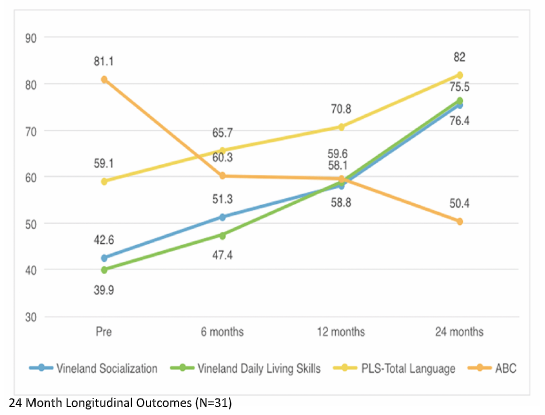
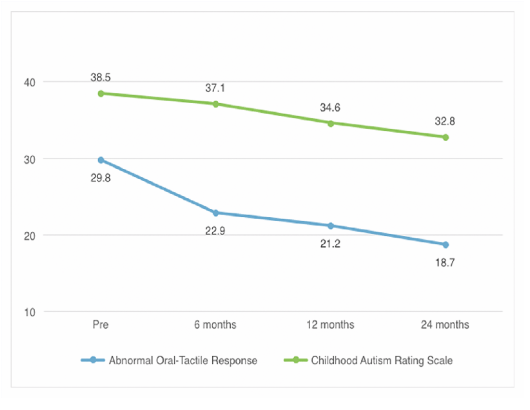
Source: The Qigong Sensory Training Institute
*Data from studies focusing on younger (under age 6) and older (6-12 years) children showed similar results.
Published Autism Studies
QST massage for 6-12-year-olds with Autism Spectrum Disorder: An extension study. Silva, L, Schalock M, Gabrielson K, Horton-Dunbar G. Published by Western Oregon University.
One and Two-year Outcomes of Treating Preschool Children with Autism with a Qigong Massage Protocol: An Observational Follow-along Study. Silva, L, Schalock M, Gabrielsen KR, Horton-Dunbar G. Journal of Alternative and Integrative Medicine 5:216. (2016).
First Skin Biopsy Reports in Children with Autism Show Loss of C-Tactile Fibers. Silva, L., Schalock, M. (2016). Journal of Neurological Disorders 4:262 (2016).
About Face: Evaluating and Managing Tactile Impairment at the Time of Autism Diagnosis. Silva, L., Schalock, M., Gabrielsen, K. (2015). Autism Research and Treatment, Volume 2015 (2015), Article ID 612507, 10 pages,
Early intervention with a parent-delivered massage protocol directed at tactile abnormalities decreases the severity of autism and improves child-to-parent interactions: a replication study. Silva, L., Schalock, M., Gabrielsen, K., Budden, S., Buenrostro, M., and Horton, G. (2015). Autism Research and Treatment, Volume 2015 (2015), Article ID 904585, 16 pages,
Treatment of Tactile Impairment in Young Children with Autism: Results with Qigong Massage. Silva, L. Schalock, M. (2013). International Journal of Therapeutic Massage and Bodywork, 6(4):12-20.
Prevalence and Significance of Abnormal Tactile Responses in Young Children with Autism. Silva, L. Schalock, M. (2013). North American Journal of Medicine and Science, 6(3):121-127.
Alternative Support for Families with Autistic Children in Lithuania. Silva, L., Vaicekauskaite, R., & Aciene, E. (2012). Tiltai/Bridges, 2(59):125-132.
Early Intervention for Autism with a Parent-delivered Qigong Massage Program: A Randomized Controlled Trial. Silva, L., Schalock, M. & Gabrielsen, K. (2011). American Journal of Occupational Therapy, 65(5):550-559.
Qigong Massage Treatment for Sensory and Self-Regulation Problems in Young Children with Autism: A Randomized Controlled Trial. Silva, L., Schalock, M., Ayres, R., Bunse, C., & Budden, S. (2009). American Journal of Occupational Therapy, 63, 423-432.
A Model and Treatment for Autism at the Convergence of Chinese Medicine and Neuroscience: First 130 Cases. Silva, L., Ayres, R., & Schalock, M. (2011). Chinese Journal of Integrative Medicine, 17(6):421-429.
Autism Parenting Stress Index: Initial Psychometric Evidence. Silva, L. & Schalock, M. (2011). Journal of Autism and Developmental Disorder.
Sense and Self-Regulation Checklist, a Measure of Comorbid Autism Symptoms: Initial Psychometric Evidence. Silva, L. & Schalock, M. (2012). American Journal of Occupational Therapy, 66(2):177-186.
Outcomes of a Pilot Training Program in a Qigong Massage Intervention for Young Children with Autism. Silva, L., Ayres, R., & Schalock, M. (September/October 2008). American Journal of Occupational Therapy, 62(5), 530-538.
Improvement in Sensory Impairment and Social Interaction in Young Children with Autism following Treatment with an Original Qigong Massage Methodology. Silva, L., Cignolini A., Warren, R., Skowron-Gooch, A., & Budden, S. (2007). American Journal of Chinese Medicine, 35(3), 393-406.
A Medical Qigong Methodology for Early Intervention in Autism Spectrum Disorder. Silva, L. & Cignolini, A. (2005). American Journal of Chinese Medicine. 33(2), 315-27.
Neural Mechanisms of Qigong Sensory Training Massage for Children With Autism Spectrum Disorder: A Feasibility Study. Jerger, K., Lundegard, L., Piepmeier, A., Faurot, K., Ruffino, A., Jerger, M., Belger, A. (2018).
Qigong Sensory Training pilot study: A tactile home program for children with or at-risk for autism, Tal-Atzili, O. & Salls, J. (2017). Journal of Occupational Therapy, Schools, & Early Intervention, DOI: 10.1080/19411243.2017.1325819.
Specific sensory techniques and sensory environmental modifications for children and youth with sensory integration difficulties: A systematic review. Bodison, S. C., & Parham, L. D. (2018). American Journal of Occupational Therapy, 72, 7201190040.
Parental or teacher education and coaching to support function and participation of children and youth with sensory processing and sensory integration challenges: A systematic review. Miller-Kuhaneck, H., & Watling, R. (2018). American Journal of Occupational Therapy, 72, 7201190030.
Interventions supporting mental health and positive behavior in children ages birth–5 yr: A systematic review. Kingsley, K., Sagester, G., & Weaver, L. L. (2020). American Journal of Occupational Therapy, 74, 7402180050.
Published Down Syndrome Studies
Improved Speech Following Parent-delivered Qigong Massage in Young Children with Down Syndrome: A Pilot Randomized Controlled Trial. Silva, L. & Schalock, M., Williams, M. (2013). Early Child Development and Care.
Qigong Massage for Motor Skills in Young Children with Cerebral Palsy and Down Syndrome. Silva, L., Schalock, M., Garberg, J., & Lammers Smith, C. (2012). American Journal of Occupational Therapy, 66(3):348-55.
All Studies, Articles, and Related Research taken from the Qigong Sensory Training Institute and full credit given.